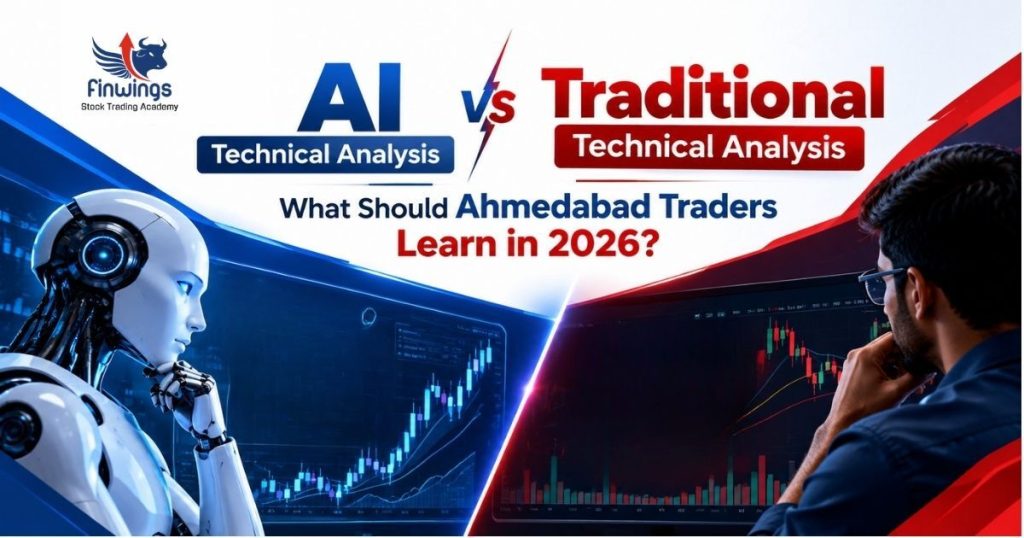
Walk past any café near Navrangpura during market hours and you’ll spot someone glued to a Nifty chart. Ahmedabad has always had a strong trading culture. What has changed is the toolkit.
Today, chart-reading apps promise AI signals in seconds. So, is trading technical analysis in Ahmedabad still worth learning the old way, or should you skip straight to the bots?
AI or Chart Reading First? The Quick Answer for Traders
Learn traditional technical analysis first, then add AI tools. Charts, candlesticks and price action teach you how markets move. AI can speed up scanning and testing, but it cannot replace your judgement or your risk control.
What Traditional Technical Analysis Still Teaches You
Good trading technical analysis in Ahmedabad starts with the basics. You learn to read trends, spot support and resistance, and check whether volume backs a move.
Candlestick analysis sits at the heart of this. A single candle shows where price opened, closed and how far buyers or sellers pushed it during the session.
Price action strategies take this further. Instead of relying on a pile of indicators, you study how price behaves at key levels and plan trades around that behaviour.
Where AI Trading Tools Help and Where They Fall Short
AI trading tools shine at jobs that take humans hours. They can scan hundreds of stocks for a pattern, backtest an idea on years of data, or summarise news in seconds.
Their weakness is context. A model trained on past data can miss a sudden policy shift, and some tools hide their logic, so you never know why a signal appeared.
Used well, they save time. Used blindly, they can turn one bad assumption into dozens of bad trades.
Skill | Traditional Technical Analysis | AI Trading Tools |
Speed | Slower, manual | Very fast scanning |
Understanding | Builds deep market sense | Often a “black box” |
Backtesting | Time-consuming | Quick and data-heavy |
Risk control | Trader-led | Depends on the user |
SEBI’s 2026 Rules on Retail Algo Trading
Regulation now matters as much as technology. SEBI’s framework for retail algo trading became fully applicable to all brokers from 1 April 2026.
Algos must now run through brokers and be registered with the stock exchanges. Black-box strategies, where the logic stays hidden, can only come from SEBI-registered research analysts.
For anyone learning trading technical analysis in Ahmedabad, this means automation is allowed, but only through approved, traceable channels.
Why Risk Management Beats Any Strategy
Neither charts nor AI guarantee profits. SEBI’s July 2025 study found that over 91% of individual equity derivatives traders made losses in FY25.
That figure is a reminder that position sizing, stop-losses and discipline decide long-term results. No tool can do that part for you. Treat every trade as a calculated risk, not a prediction.
A Smart Learning Path for Traders in Ahmedabad
A sensible route into trading technical analysis in Ahmedabad looks like this:
- Start with candlestick analysis to read market psychology.
- Practise price action strategies on demo trades before using real money.
- Add AI trading tools for scanning and backtesting once your basics are solid.
- Follow SEBI’s rules and use only exchange-registered algo products.
Your Edge Starts With Reading the Chart Yourself
AI will keep getting faster, but understanding still belongs to the trader. The best results in 2026 come from combining human judgement with smart tools, not swapping one for the other.
If you want to learn trading technical analysis in Ahmedabad with live market practice, Finwings Academy offers offline and online classes taught by experienced traders. Building strong technical analysis skills for trading today will help you use tomorrow’s tools with confidence.
FAQs :
1. Can AI trading tools replace technical analysis?
No. AI trading tools can scan charts and test ideas quickly, but they rely on past data and can miss sudden events. You still need technical analysis to judge whether a signal makes sense, manage risk and decide when to stay out of the market.
2. Is candlestick analysis still useful for traders in 2026?
Yes. Candlestick analysis remains one of the clearest ways to read buyer and seller behaviour on a chart. Many pattern scanners look for these same candle formations, so understanding them helps you clearly check whether an automated signal is actually worth acting on in real trades.
3. Is algo trading legal for retail traders in India?
Yes, within SEBI’s framework, which became fully applicable to brokers from 1 April 2026. Retail traders must use algos offered through their broker and registered with the exchanges. Strategies with hidden logic can only be provided by SEBI-registered research analysts. Always check that your broker’s product is exchange-approved.
4. How long does it take to learn technical analysis properly?
Most beginners grasp chart basics within a few weeks, but real confidence takes months of practice. Working on price action strategies with demo or small trades helps you learn faster, because you see how theory behaves in live market conditions without risking too much capital.
5. Do I need coding skills to use AI in trading?
Not necessarily. Many broker platforms now offer ready-made scanners and AI-assisted tools that need no coding. However, building or customising your own algorithm does require programming knowledge, and it must still follow SEBI’s rules on registration and approved broker access. Start simple and learn the rules first.