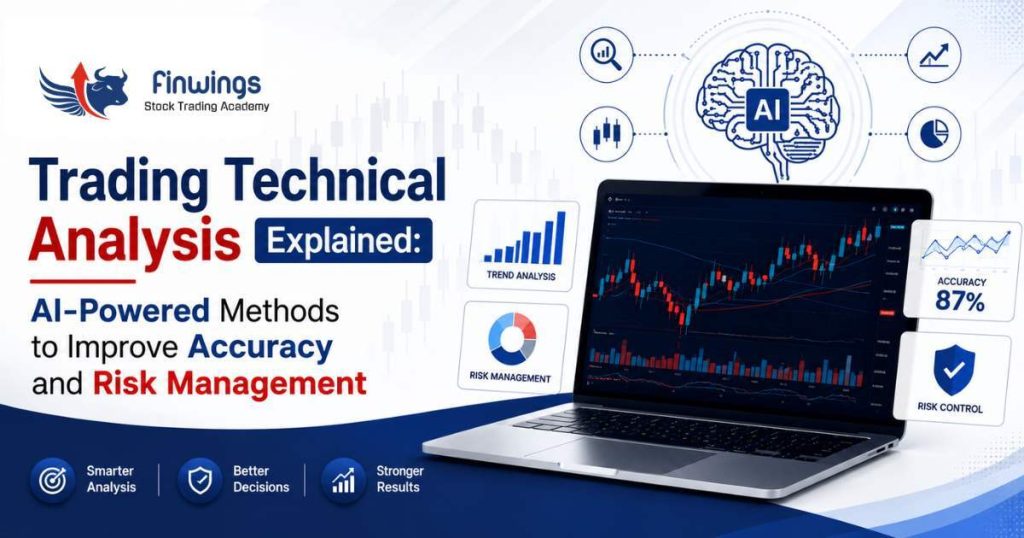
Successful trading is not based on prediction alone – it relies on interpreting market behaviour through structured analysis and disciplined decision-making. Technical analysis in trading enables traders to study historical price movements, chart patterns, and market trends to identify potential trading opportunities. With the growing adoption of artificial intelligence (AI), technical analysis has become more data-driven, helping traders improve accuracy while managing risk more effectively.
Rather than replacing trader judgement, AI enhances traditional analysis by processing large datasets, identifying hidden market patterns, and delivering faster insights. Understanding how these tools complement conventional chart analysis can help traders make more informed decisions in dynamic financial markets.
How Does Technical Analysis in Trading Combined with AI Improve Market Decisions?
Technical analysis in Trading uses historical price data, chart patterns, and statistical tools to evaluate potential market movements. When combined with AI, traders gain faster pattern recognition, improved market monitoring, and enhanced risk management, allowing for more informed trading decisions without eliminating the need for sound trading discipline.
Understanding Trading Technical Analysis
Technical analysis is the process of evaluating securities by examining price charts, trading volume, and historical market behaviour rather than focusing primarily on financial statements or economic fundamentals.
The underlying principle is that market prices often reflect available information, while recurring patterns and trends may provide valuable insights into future price behaviour. Although no method guarantees profits, technical analysis helps traders develop structured trading plans supported by objective data.
Core Elements of Technical Analysis
Several foundational concepts remain essential regardless of trading style.
Chart Patterns and Price Behaviour
Understanding price action trading enables traders to interpret how buyers and sellers interact within the market. Candlestick formations, breakout patterns, and consolidation zones often provide valuable clues about potential market direction without relying solely on mathematical indicators.
Support and Resistance Levels
Identifying support and resistance areas helps traders recognise price zones where buying or selling pressure may increase. These levels are commonly used to plan entries, exits, stop-loss placement, and profit targets while improving overall trade structure.
Technical Indicators
Widely used technical indicators such as moving averages, the Relative Strength Index (RSI), MACD, and Bollinger Bands help traders evaluate momentum, volatility, and trend strength. These indicators are generally most effective when combined rather than used independently.
How AI Enhances Technical Analysis
Artificial intelligence has significantly expanded the capabilities of modern trading analysis.
AI-powered systems can:
- Analyse vast quantities of historical and live market data.
- Detect complex chart patterns rapidly.
- Identify statistical relationships that may be overlooked manually.
- Monitor multiple financial instruments simultaneously.
- Generate alerts based on predefined trading conditions.
- Assist traders in evaluating potential risk before entering positions.
Importantly, AI provides analytical support rather than guaranteed predictions. Human judgement remains essential for interpreting market context and executing disciplined trading strategies.
Improving Risk Management
Accurate analysis alone does not ensure trading success. Effective risk management remains equally important.
Traders can strengthen their approach by:
- Defining maximum acceptable loss before every trade.
- Using appropriate position sizing.
- Following predetermined exit strategies.
- Avoiding emotionally driven decisions.
- Reviewing trading performance regularly.
AI tools can assist by evaluating probabilities and monitoring exposure, but disciplined execution ultimately determines long-term consistency.
Combining Technology with Trading Education
Technology continues to evolve, yet successful traders understand that no software replaces market knowledge. Learning chart interpretation, understanding market psychology, and developing structured trading plans remain fundamental skills.
Continuous education allows traders to use AI-powered tools responsibly while maintaining realistic expectations about market uncertainty.
Key Takeaways
As financial markets become increasingly data-driven, technical analysis in trading continues to evolve through the integration of artificial intelligence. AI enhances traditional chart analysis by improving speed, identifying patterns, and supporting better risk management, while disciplined decision-making remains the foundation of successful trading.
Developing strong analytical skills alongside modern technology enables traders to make more informed market decisions. Finwings Academy provides practical education designed to help aspiring and experienced traders understand technical analysis, strengthen risk management practices, and confidently navigate today’s financial markets.
Frequently Asked Questions:
1. What is technical analysis in trading?
Technical analysis in trading is the study of historical price movements, chart patterns, and trading volume to identify potential market opportunities. Traders use this approach to evaluate trends, manage risk, and develop structured strategies without relying solely on company fundamentals or economic news.
2. Why are support and resistance levels important?
Support and resistance levels help traders identify areas where prices may reverse, pause, or break through. These zones assist in planning entries, exits, stop-loss orders, and profit targets while improving trade structure and overall decision-making across different market conditions.
3. Can AI improve technical analysis?
Yes. AI enhances market analysis by processing large datasets, identifying recurring patterns, generating alerts, and supporting faster decision-making. However, it should complement – not replace – human judgement, disciplined risk management, and a well-defined trading strategy based on sound analytical principles.
4. Which technical indicators are commonly used by traders?
Popular technical indicators include moving averages, RSI, MACD, Bollinger Bands, and stochastic oscillators. Traders often combine multiple indicators with chart analysis to confirm signals, assess momentum, and improve the reliability of trading decisions rather than relying on a single tool.
5. Is technical analysis suitable for beginners?
Yes. Beginners can learn technical analysis through structured education, regular chart practice, and disciplined risk management. Starting with basic concepts before progressing to advanced strategies helps build confidence, improve decision-making, and develop consistent trading habits over time.