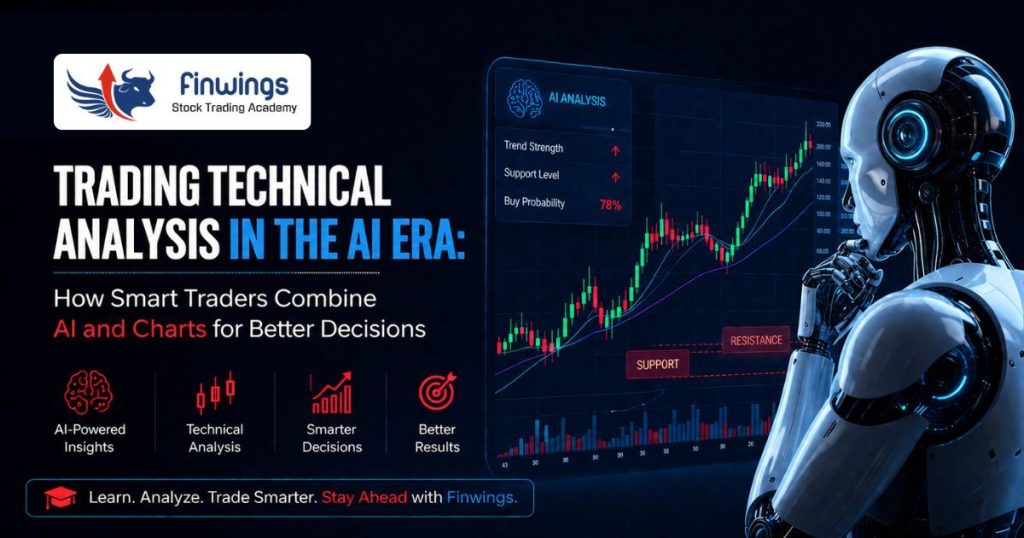
Financial markets are evolving rapidly, and technology is transforming the way traders interpret price movements. While artificial intelligence has introduced faster data processing and predictive capabilities, successful market participants continue to rely on trading technical analysis to validate opportunities before making decisions. Rather than replacing traditional methods, AI complements technical analysis by identifying patterns, filtering noise, and supporting disciplined trading strategies. Understanding how these approaches work together helps traders make more informed, data-driven decisions in today’s increasingly dynamic markets.
This blog explains how traders combine AI with technical analysis, charts, and proven market strategies to improve accuracy and make more informed trading decisions.
How Does Trading Technical Analysis Work Alongside AI for Smarter Trading?
Technical analysis remains the foundation for evaluating market trends, while AI enhances the process by analysing vast amounts of market data in seconds. Together, they help traders identify high-probability opportunities, reduce emotional bias, and make decisions based on structured insights rather than assumptions.
Why Technical Analysis Still Matters
Technical analysis focuses on interpreting historical price movements, trading volumes, and market behaviour to anticipate potential future trends. Although markets have become increasingly technology-driven, price action continues to reflect collective market sentiment. This makes charts an essential decision-making tool for traders across equities, commodities, currencies, and derivatives.
Successful traders rarely depend on a single signal. Instead, they combine multiple analytical techniques to build confidence before entering or exiting a trade. This disciplined approach remains relevant regardless of technological advancements.
How AI Enhances Modern Trading
Artificial intelligence excels at processing enormous datasets far beyond human capability. Today’s AI trading tools can scan thousands of securities, detect unusual price activity, identify recurring market behaviour, and generate real-time insights within seconds. These capabilities allow traders to monitor multiple markets simultaneously while saving valuable research time.
However, AI does not guarantee profitable trades. Its effectiveness depends on data quality, market conditions, and the trader’s ability to interpret outputs correctly. Human judgement remains essential when evaluating risk, confirming signals, and adapting to unexpected market events.
Combining Charts with AI for Better Decisions
Experienced traders use AI as a decision-support system rather than an automatic trading solution. Traditional chart pattern analysis remains valuable for recognising trends such as breakouts, consolidations, reversals, and continuation formations. AI can quickly identify these structures, but traders should still confirm them using broader market context.
Similarly, recognising candlestick patterns helps traders understand short-term market psychology. Formations such as bullish engulfing, hammer, or shooting star often provide additional confirmation when combined with support and resistance levels.
Many professionals also rely on established trading indicators, including moving averages, the Relative Strength Index (RSI), and the Moving Average Convergence Divergence (MACD). AI can evaluate multiple indicators simultaneously, highlight stronger probability setups, and reduce information overload without replacing analytical discipline.
Ultimately, combining AI with technical analysis creates a balanced trading framework. Technology improves efficiency, while human expertise ensures rational decision-making, effective risk management, and continuous adaptation to changing market conditions.
Key Takeaways
The future of trading lies in combining innovation with proven analytical principles. While AI improves speed, pattern recognition, and data analysis, technical analysis continues to provide the structure needed for confident decision-making. Traders who understand both technologies are better equipped to evaluate opportunities objectively and manage risk effectively. For individuals looking to build practical market knowledge through structured learning, Finwings Academy offers industry-focused programmes that integrate modern trading concepts with strong technical analysis fundamentals.
FAQs :
1. Can beginners learn technical analysis even with AI becoming popular?
Yes. Learning trading technical analysis remains essential because it helps beginners understand market behaviour, price trends, and risk management. AI can support analysis, but traders who understand charts are better prepared to evaluate signals critically rather than relying entirely on automated recommendations.
2. Do AI trading tools guarantee profitable trades?
No. AI trading tools improve market analysis by identifying trends and processing large datasets quickly, but they cannot eliminate market risk. Successful trading still depends on strategy, disciplined execution, proper risk management, and adapting to changing market conditions instead of following automated outputs blindly.
3. Why are chart patterns still important in modern trading?
Despite advances in technology, chart pattern analysis continues to help traders recognise recurring market behaviour, identify trend reversals, and confirm breakout opportunities. Combining pattern recognition with broader market context improves decision-making and provides additional confidence before entering or exiting a position.
4. Which technical indicators are commonly used by professional traders?
Professional traders commonly use moving averages, RSI, MACD, Bollinger Bands, and volume-based indicators to assess momentum, trend strength, and potential reversals. Rather than relying on a single indicator, experienced traders combine multiple signals alongside price action to improve the quality of their trading decisions.
5. How do candlestick patterns improve trading decisions?
Candlestick patterns provide visual insights into buyer and seller sentiment during a specific trading session. When combined with support, resistance, and trading indicators, these formations help traders validate potential reversals or trend continuation, strengthening overall decision-making while reducing reliance on isolated market signals.