Opening a demat account takes about ten minutes. Learning to trade without losing your shirt? That takes rather longer.
Most new traders don’t fail because they’re unlucky. They fail because nobody showed them the basics. A good stock trading academy in Ahmedabad fills that gap before your savings are at stake, and these seven skills are where it should start.
What Should a Beginner Learn First at a Stock Trading Academy in Ahmedabad?
Begin with how the market works, how to read a chart and how to manage risk. Those three keep your capital safe while you learn. Fundamentals, psychology and derivatives can come next.
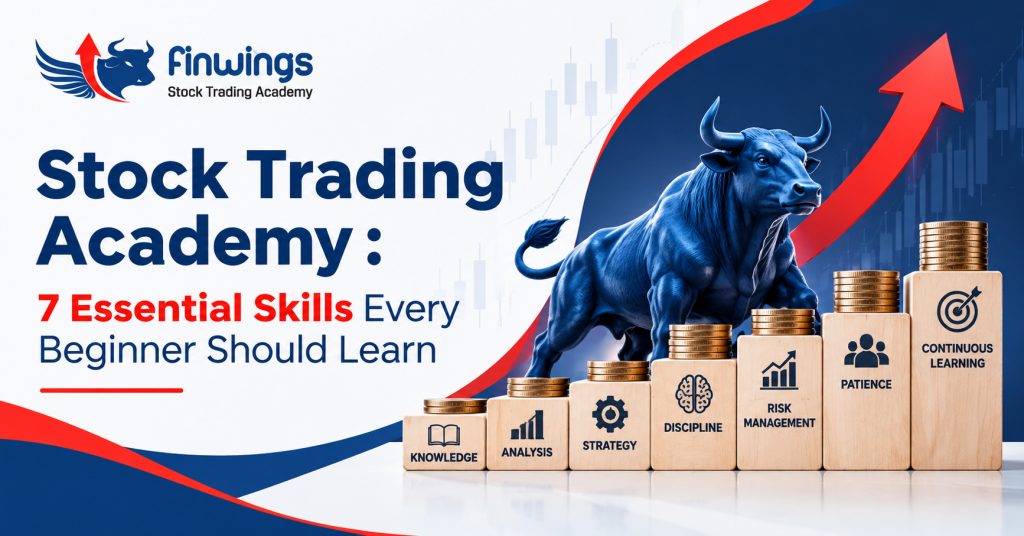
7 Skills a Stock Market Training Institute Should Teach You
- How the Market Actually Works
What does SEBI regulate? How does an order get matched on NSE or BSE? Why does your money show up a day later? (That’s the T+1 settlement cycle.) Get comfortable with market, limit and stop-loss orders, and find out what circuit limits do on a wild day.
- Reading a Price Chart
Candlesticks look confusing at first. Give it a few weeks and support, resistance, trendlines and volume start to make sense. A decent stock market training institute will also warn you about the trap of seeing patterns that simply aren’t there.
- Fundamental Analysis
Charts tell you when. Fundamentals tell you what. You’ll want to read a balance sheet, understand a P/E ratio and spot a company carrying too much debt, especially if you plan to hold for more than a week.
- Managing Risk
This is the big one. Put a stop-loss in before you enter. Keep each position small. Many professionals risk only a sliver of their capital on a single trade, and they take small losses without arguing with the market.
- Trading Psychology
Here’s the uncomfortable truth: your own emotions are often your biggest opponent. Revenge trades after a loss, chasing a stock that’s already flown, nudging a stop-loss “just a little” further away. Good stock trading mentorship catches these habits early, long before they get expensive.
- Derivatives, and Why They Bite
Futures and options look exciting because of leverage. The numbers are sobering, though. SEBI’s own study found 91% of individual F&O traders made net losses in FY25, and the regulator has tightened F&O rules since 2024. Learn margins, expiry and option pricing properly first.
- A Written Plan and a Trading Journal
Before every trade, write down your entry, exit, stop-loss and size. Afterwards, note what happened and why you took it. Read the journal back each weekend. It’s humbling, and it teaches more than most books.
Choosing the Right Stock Trading Academy in Ahmedabad
A reliable stock trading academy in Ahmedabad should have experienced trainers, a clear syllabus and simulator practice before you risk real money. Ask what their live trading classes actually involve. Interactive, instructor-led sessions are great. Tips and buy calls are a red flag.
SEBI rules stop education providers from giving advice or promising returns, and teaching material has to use lagged market data. So if an academy guarantees profits, walk away. Check whether live trading classes come with recordings and whether stock trading mentorship continues afterwards.
Your First Trade Deserves a Strong Foundation
Nobody masters the market in a month. Get these seven skills right, though, and you’ll walk in with a plan instead of a hunch.
Looking for a stock trading academy in Ahmedabad that takes beginners seriously? Finwings Academy offers structured courses, practical sessions and experienced mentors. Picking the right one might just be the best trade you make this year.
FAQs :
How long does it take to learn stock trading?
The basics usually click within two or three months of steady learning. Real consistency takes longer, often a year or more of practice, journaling and honest review. Markets keep changing, so even experienced traders are still learning something new from their trades every single week.
Do I need a finance degree to join a stock trading course?
Not at all. Most courses accept anyone over 18 with basic maths and English. A good stock market training institute starts from scratch, explaining market terms, order types and charts step by step, so students from engineering, commerce or arts can all keep up comfortably.
Can I learn stock trading online instead of in a classroom?
Yes, provided the course is structured and interactive. Look for live trading classes where you can ask questions in real time, plus recordings for revision and simulator practice. Plenty of beginners like a mix of online and classroom sessions, which gives them flexibility and accountability.
Is stock trading mentorship worth it for beginners?
Usually, yes. Stock trading mentorship gives you honest feedback on your trades and helps you fix emotional mistakes before they cost real money. No mentor can promise profits, of course, but regular guidance shortens the learning curve and keeps you accountable when discipline starts to slip.
How much money do I need to start trading in India?
There’s no fixed minimum, and you can buy a single share if you like. Still, start small and only use money you can afford to lose. Practise on a simulator first, then trade tiny positions while your skills, discipline and confidence slowly grow over time.